
You Searched for:
17112 Results
SORT
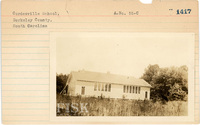
Cordesville School in Berkeley County, South Carolina
Photo of Cordesville School in Berkeley County, South Carolina
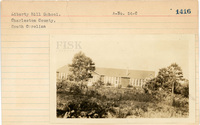
Liberty Hill School in Charleston County, South Carolina
Photo of Liberty Hill School in Charleston County, South Carolina
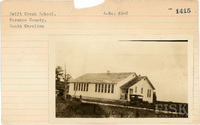
Swift Creek School in Kershaw County, South Carolina
Photos of Swift Creek School in Kershaw County, South Carolina
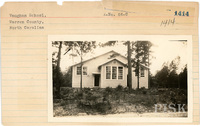
Vaughan School in Warren County, North Carolina
Photo of Vaughan School in Warren County, North Carolina
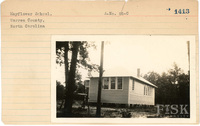
Mayflower School in Warren County, North Carolina
Photos of Mayflower School in Warren County, North Carolina
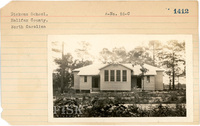
Dickens School in Halifax County, North Carolina
Photos of Dickens School in Halifax County, North Carolina
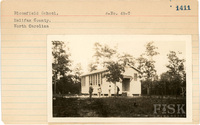
Bloomfield School in Halifax County, North Carolina
Photos of Bloomfield School in Halifax County, North Carolina
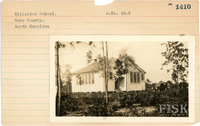
Millsides School in Hoke County, North Carolina
Photo of Millsides School in Hoke County, North Carolina
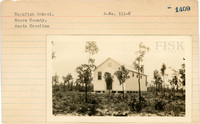
Rockfish School in Moore County, North Carolina
Photo of Rockfish School in Moore County, North Carolina
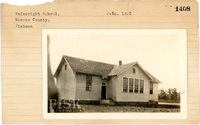
Wainwright School in Monroe County, Alabama
Photos of Wainwright School in Monroe County, Alabama
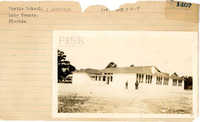
Eustis School in Lake County, Florida
Photos of Eustis School and addition to Lake County, Florida including 2 unidentified persons standing on the grassland nearby.
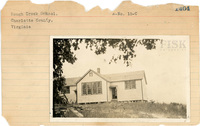
Rough Creek School in Charlotte County, Virginia
Photos of Rough Creek School in Charlotte County, Virginia
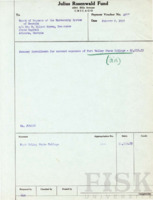
Fort Valley State College Financial Records and Program Expansion Correspondence, 1941–1943
This collection includes checks and correspondence between Dorothy Elvidge, Dr. Horace Mann Bond, Mr. Bywaters, Fred G. Wale, and W. Wilson Noyes concerning the disbursement of monthly installments from the Julius Rosenwald Fund pledge to Fort Valley State College. It contains the state audit and statement of operations for the fiscal year July 1941–June 1942, the proposed budget for the year ending June 30, 1943, and the actual income and expenditures for the six-month period from July 1, 1942–December 31, 1942. Additionally, the collection includes discussions on introducing a biology program to the college curriculum.

Fort Valley State College Financial and Operational Reports, 1939–1942
This collection includes checks, construction invoices, and correspondence between Dorothy Elvidge, Dr. Horace Mann Bond, and Mr. Bywaters. It contains the statement of operations for Fort Valley State College for the 1939–1940 fiscal year, the following six months (July–December 1940), and the summer of 1941. Additionally, it includes a report of examination of the college through June 30, 1941, along with an estimated budget for the fiscal year ending June 30, 1942.
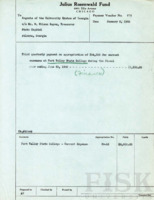
Fort Valley State College Financial and Administrative Records, 1940
This collection consists of correspondence between Dorothy Elvidge, Dr. Horace Mann Bond, Edwin R. Embree, and Wilson Noyes regarding expected quarterly payment checks for expenses at Fort Valley State College. It includes the statement of operations for the year ending June 30, 1940, the budget for the year ending June 30, 1941, and projected budgets with proposed funding sources for the years ending 1942, 1943, 1944, and 1945.
Additionally, the collection contains a state audit report for the year ending June 30, 1940, proposed building plans and cost estimates for Fort Valley State College, and documents related to the transfer of Fort Valley Normal and Industrial Institute to state control. It also includes records of actual income and expenditures for the six-month period from July 1, 1940, to December 31, 1940.
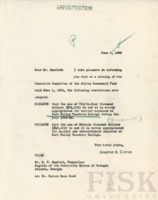
Fort Valley Normal and Industrial School Report and Budget Correspondence, 1939–1940
This collection contains correspondence between various parties, including a report detailing the examination of Fort Valley Normal and Industrial School for the 14-month period ending in July 1939. It also includes a proposed budget for the newly named Fort Valley State College, as approved by the Regents, for the fiscal year ending June 1940.
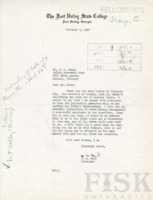
Cornelius Vanderbilt Troup Fellowship Correspondence and Grant Records, 1940 - 1941
This collection includes letter correspondence, checks, and payment records concerning Cornelius Vanderbilt Troup's fellowship. Key individuals include Dr. Horace Mann Bond, Mr. J.C. Dixon, Dorothy Elvidge, and Edwin R. Embree. The materials document the approval and disbursement of a $2,000 grant, with an additional $300 awarded, enabling Mr. Troup to study under Dr. Nelson L. Bossing at the University of Minnesota.
The collection also contains Mr. Troup's fellowship application documents, a detailed plan of work, and recommendation letters from W.A. Robinson, Miss Hattie V. Feger, and Dr. Horace Mann Bond.
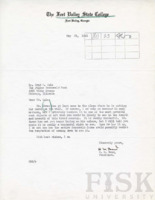
Lawrence A. Jones Fellowship Correspondence and Financial Records, 1941–1942
This collection comprises correspondence, checks, and payment records related to Lawrence A. Jones, a faculty member at Fort Valley State College in Georgia. Key individuals include Dr. H.M. Bond, Fred G. Wale, Dorothy Elvidge, William C. Haygood, and Robert C. Smith. The documents detail the approval and disbursement of an $800 expenditure for Mr. Jones to pursue studies in Mexico from July 1941 to January 1942.
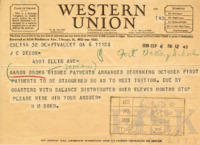
Aaron J. Brown Fellowship and Dissertation Correspondence, 1939–1942
This collection features correspondence, checks, and payment records related to Aaron J. Brown, a faculty member at Fort Valley State College in Georgia, during his fellowship to study at the University of Chicago from 1939 to 1940. Key figures in the correspondence include Dr. Horace M. Bond, Dr. J.C. Dixon, Miss Dorothy A. Elvidge, and Mr. Fred G. Wale. The materials document checks received by Mr. Brown throughout his fellowship.
Additionally, the collection includes letters involving these individuals and John Dale Russell, a professor of education at the University of Chicago, concerning a $200 grant awarded in 1942. This grant supported Mr. Brown’s travel plans to visit high schools for research related to his doctoral dissertation proposal, conducted under R.W. Tyler.
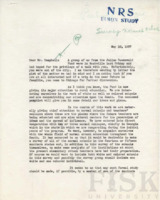
Correspondence on a Southern Study of Rural Teacher Training
This collection contains letters and meeting notes about a planned study on how rural and elementary teachers are trained in the South. The project was organized by the Julius Rosenwald Fund, with Dr. Doak Campbell from George Peabody College set to lead it. The idea was to take a close look at normal schools, figure out what makes a good rural school and teacher, and then use that to shape better teacher preparation. The letters go over funding, possible team members, and the suggestion to focus on a few key states or regions. There’s also an emphasis on working with both Black and white educators and grounding the project in Southern institutions.
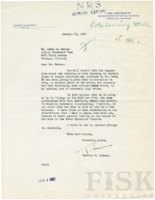
Rote Learning in Southern Rural Schools
This collection contains documents and correspondence centered on a study of rote learning in rural Black schools, led by Charles S. Johnson and Robert E. Park at Fisk University. It includes letters and a long memo from Park, where he reflects on how students often memorize without really understanding, especially when lessons don’t connect to their lives. He talks about how this pattern is tied to history, lack of books, and a gap between school and community. Park suggests trying something different: a school that works with the whole community, focuses on real issues like public health, uses local news and film to spark interest, and makes learning more about thinking than repeating.
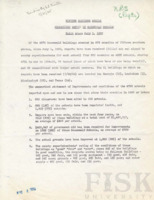
In-Depth Report on Rural School and Community Work in Fitzhugh, Arkansas
This collection contains report by John Gammon Jr. on the Fitzhugh Community in Arkansas, where he worked as a vocational agriculture teacher. It describes the makeup of the community, the condition of homes, and how six small schools were combined into one. Gammon outlines his five-year plan to improve things like sanitation, home gardens, poultry, and school attendance. He talks about the progress made through evening classes, canning clubs, and a poultry association that served both Black and white families. He also discusses the resistance he faced from local preachers, the limits put on students by their families and landlords, and the need for more teachers and better coordination within the school.
Digest of the First Diaries of the Explorers
This collection contains a journal summarizing the first field reports from rural school explorers, who recorded daily life in Southern Black communities. It captures local customs, superstitions, family roles, school attitudes, and community tensions. The entries come from places like Fair Play and Red Oak in Georgia, Pine Bluff in Arkansas, and Washington Parish in Louisiana. Observations cover how people talk, what they value, what divides or unites them, and how schools fit into their lives. There are also notes on teacher quality, church influence, and hopes or confusion about help from the Rosenwald Fund.
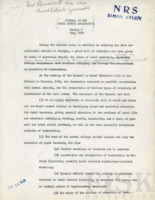
Journal of the Rural School Exploration Number 9
This collection contains Volume 9 of Journal of the Rural School Exploration. The journal documents efforts to expand rural education through collaboration with teacher colleges and the development of instructional materials. It reports on discussions at the Council on Rural Education in New Orleans, recommending cooperation with both white and Black normal schools, beginning with South Georgia Teachers College. They had plans of adding departments in agriculture, industrial arts, rural sociology, health, and reading, and using demonstration schools for field training. There were plans and efforts to develop appropriate reading materials for rural children, including new books written by authors like Winifred Wise and Arna Bontemps.
Journal of the Rural School Exploration Number 8
This collection contains Volume 8 of Journal of the Rural School Exploration. The journal provides an in-depth study of rural schools in British Columbia, covering the region’s geography, history, and school system. It describes the development of public education from the days of the Hudson Bay Company to a government-supported system.The journal details the province’s health initiatives in schools, including annual medical exams, trained public health nurses, and a unified health service. There was also an experimental centralization program in the Peace River District, led by Inspector W. Plenderleith, which united multiple schools under one official trustee. The report was now concluded with recommendations to extend this centralized model across the entire province.