-
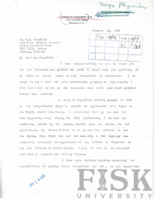 Fellowship Application of Virginia M. Alexander
 A letter of correspondence from Virginia M. Alexander to Dr. M.O. Bousfield written on December 13, 1935. Ms. Alexander desired to write Dr. Bousfield after securing state or city recognition, but she had to settle some local poltical issues. Ms. Alexander relayed that Dr. William C. Hunsicker was appointed the new Director of Public Health a few days prior, so she planned on acquainting him with her project.
-
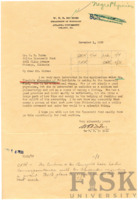 Fellowship Application of Virginia M. Alexander
 A letter of correspondence from W.E.B. Du Bois to Mr. C.R. Rorem written on November 1, 1935. Mr. Du Bois expressed interest in Virginia Alexander of Philadelphias application to the Rosenwald Fund. Mr. Du Bois described Dr. Alexander as an exceptional woman, one of good practice and could easily be well to do, he emphasized that Dr. Alexander was interested in Medicine as a science and philantropy and not as a means of making a living.
-
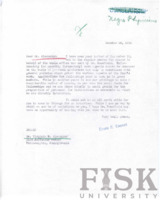 Fellowship Application of Virginia M. Alexander
 A letter of correspondence from Edwin R. Embree to Dr. Virginia M. Alexander written on October 28, 1935. Mr. Embree acknowledged Dr. Alexanders letter of September 16. Mr. Embree informed her that the funds the Rosenwald Fund could grant were very limited, and he also mentioned that it would not be worth while for Dr. Alexander to come to Chicago for an interview.
-
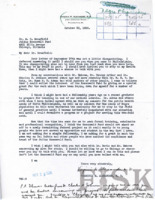 Fellowship Application of Virginia M. Alexander
 A letter of correspondence from Virginia M. Alexander to Dr. M.O. Bousfield written on October 23, 1935. Ms. Alexander acknowledged Dr. Bousfields letter of September 27. She was also disappointed that she could not visit Dr. Bousfield while he was in Philadelphia. Ms. Alexander had thought she could get a fellowship through her conversations with Mr. Embree, Mr. George Arthur, Dr. Charles S. Johnson, Dr. W.E.B. Du Bois, Dr. Numa P.G. Adams, and a few others, especially given her concerns for the needs of Negro physicians in North Philadelphia. Ms. Alexander suggested the Rosenwald Fund dont shunt off to a federal project in development at the time, and she wanted to talk to Dr. Bousfield, Dr. Davis, and Mr. Embree about it.
-
 Fellowship Application of Virginia M. Alexander
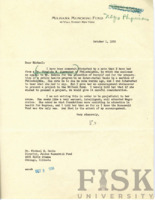
 A letter of correspondence to Dr. Michael M. Davis written on October 1, 1935. Virginia M. Alexander of Philadelphia had appealed to Mr. Embree for her education and for the preparation of a Public Health program on an interracial basis in a section of Philadephia. Her appeal went nowhere, but she was suggested to present a project to the Milbank Fund.
-
 Fellowship Application of Virginia M. Alexander
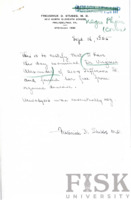
 A letter of correspondence from Frederick D. Stubbs handwritten on September 16, 1935. Mr. Stubbs had examined Virginia Alexander of 2104 Jefferson St., and he certified that Dr. Alexander was free from organic disease through urinalysis.
-
 Fellowship Application of Virginia M. Alexander
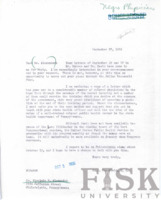
 A letter of correspondence from M.O. Bousfield to Dr. Virginia M. Alexander written on September 27, 1935. Mr. Bousfield acknowledged Dr. Alexanders letter of September 16 to Mr. Embree and that of September 17 to Dr. Davis. Mr. Bousfield informed Dr. Alexander that it would be impossible to carry out her plans through the Rosenwald Fund at the time. Mr. Bousfield mentioned he would enclose a copy of a letter which had gone out to a considerable number of Negro physicians, in hopes that a few would be supported by the Social Security Act. Mr. Bousfield relayted that he would be in Philadelphia about October 19.
-
 Fellowship Application of Virginia M. Alexander
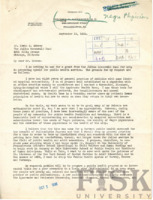
 A letter of correspondence from Virginia M. Alexander to Dr. Edwin R. Embree written on September 16, 1935. Ms. Alexander requested for a grant from the Julius Rosenwald Fund, and she detailed her professional experience. Ms. Alexander had 8 years of general practice of Medicine with some limited hospital connections, but she dropped her general practice for disciplinary research because Ms. Alexander believed the time had come for a forwatrd public health movement for the benefit of Philadelphia Negroes. For her research problem, Ms. Alexander chose to prepare a public health program on an inter racial basis for a poor community in the large city of Philadelphia. On a different note, Ms. Alexander was a member of the Society of Friends.
-
 Fellowship Application of Virginia M. Alexander
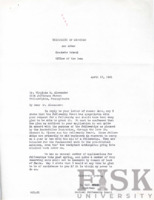
 Letters of correspondence between Dr. Virginia M. Alexander, G. Carl Huber, J.C. Doane, and Faith S. Fetterman written on April 17, 1931. The Julius Rosenwald Fund was not able to grant Dr. Alexander a fellowship in response to her application.
-
 Fellowship Application of Virginia M. Alexander
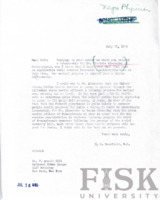
 A letter of correspondence from M.O. Bousfield to Mr. T. Arnold Hill written on July 11, 1975. Mr. Bousfield was doubtful if an application from Virginia Alexander of Philadelphia would receive favorable consideration at the time. Mr. Bousfield suggested Dr. Alexandar consider the United States Public Health Service as a means of support.
-
 Fellowship Application of Virginia M. Alexander
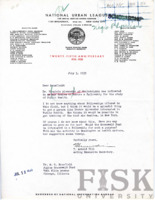
 A letter of correspondence from T. Arnold Hill to Dr. M.O. Bousfield written on July 3, 1935. Virginia Alexander expressed to Mr. Hill her desire to secure a fellowship for her study of Public Health. Mr. Hill inquired Dr. Bousfield if the Rosenwald would be interested in a fellowship for Dr. Alexander.
-
 Fellowship Application of Virginia M. Alexander
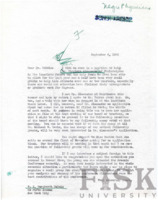
 A letter of correspondence to W.E. Burghardt Du Bois written on September 6, 1933. The funds available to the Rosenwald Fund at the time were very limited, so they wouldnt be able to support Virginia Alexander of Philadelphia.
-
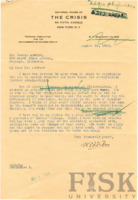 Fellowship Application of Virginia M. Alexander
 A letter of correspondence from W.E.B. Du Bois to Mr. George R. Arthur written on August 7, 1933. Mr. Du Bois recommended Virginia Alexander of Philadelphia, and he enclosed an article written about her at the time. He described Dr. Alexander as a gifted physician, she wasnt in the practice simply to make money, but she was passionate about the advancement of knowledge, especially in helping Negroes.
-
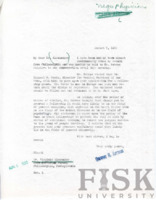 Fellowship Application of Virginia M. Alexander
 A letter of correspondence from George R. Arthur to Dr. Virginia Alexander written on August 7, 1933. Mr. Embree relayed that Dr. Michael M. Davis (director for medical services of the Rosenwald Fund) would pass upon Dr. Alexanders application, so she had to fill out application blank by September, when Dr. Davis would return from Europe.
-
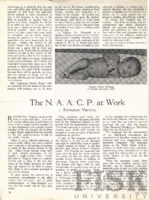 Fellowship Application of Virginia M. Alexander
 A newspaper article with the following headlines, The N.A.A.C.P. at work and Can a Colored Woman be a Physician? The second headline had Virginia M. Alexander as the focus of the article, along with a portrait picture of Dr. Alexander.
-
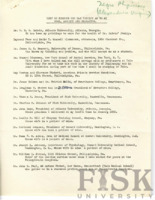 Fellowship Application of Virginia M. Alexander
 A document from Virginia Alexander titled List of Persons w+ho can Testify as to My Work, Ability, and Character.
-
 Fellowship Application of Virginia M. Alexander
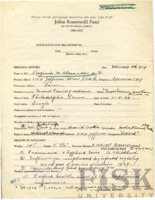
 An application from Virginia M. Alexander for a fellowship. Ms. Alexander was in the General Practice of Medicine at the time. This application was submitted on February 1, 1934.
-
 Fellowship Application of John Beauregard Johnson
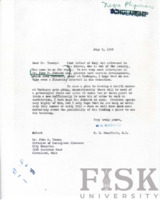
 A letter of correspondence from M.O. Bousfield to Dr. John A. Toomey written on July 6, 1936. Mr. Bousfield acknowledged Dr. Toomeys letter to Mr. Embree (he was out of the counrty at the time). Mr. Bousfield mentioned that they were interested in John B. Johnson, and Dr. Johnsons expertise in Pathology would be needed for the Tuskegee health center that was in development at the time.
-
 Fellowship Application of John Beauregard Johnson
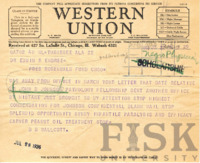
 A telegram from B.B. Wallcott to Dr. Edwin R. Embree sent on July 22, 1936. Mr. Wallcott mentioned that he was away from office in March, so he missed Dr. Embrees letter. Mr. Wallcott mentioned he found a splendid opportunity for John B. Johnson to study Infantile Paralysis and Efficacy Carver Peanut Oil Treatment.
-
 Fellowship Application of John Beauregard Johnson
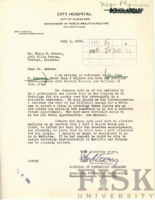
 A letter of correspondence from John A. Toomey to Dr. Edwin R. Embree written on July 1, 1936. Mr. Toomey recalled Dr. Johnsons ambition to be a Pathologist, but he informed Dr. Johnson that a career in Pathology would be more difficult for a Negro man than it already was.
-
 Fellowship Application of John Beauregard Johnson
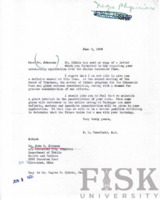
 A letter of correspondence from M.O. Bousfield to Dr. John B. Johnson written on June 3, 1936. Mr. Bousfield acknowledged Dr. Johnsons letter to Dr. Dibble regarding his scholarship application with the Julius Rosenwald Fund. Mr. Bousfield relayed that he could not give Dr. Johnson a definitive answer at the time because the matter of future programs for the Rosenwald Fund was given serious consideration at the prior meeting of the Board of Trustees.
-
 Fellowship Application of John Beauregard Johnson
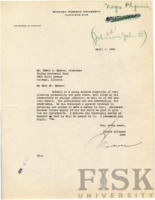
 A letter of correspondence from Torald Sollmann to Mr. Edwin R. Embree written on April 1, 1936. Mr. Sollmann mentioned that Professor Karsner thought highly of Johnson and would be glad to give him an opportunity. Mr. Sollmann also recommended him highly.
-
 Fellowship Application of John Beauregard Johnson
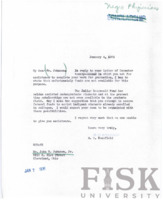
 A letter of correspondence from M.O. Bousfield to Mr. John B. Johnson, Jr. written on January 4, 1935. Mr. Bousfield acknowledged Mr. Johnsons letter of December 22, 1934. Mr. Bousfield relayed that the Julius Rosenwald Fund scholarships werent available in the graduate field, so he suggested Mr. Johnson attempt to secure federal funds.
-
 Fellowship Application of John Beauregard Johnson
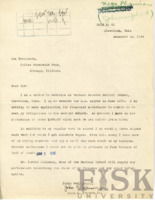
 A letter of correspondence from John B. Johnson, Jr. written on December 22, 1934. Mr. Johnson was senior in Medicine at Western Reserve Medical School, Cleveland, Ohio, and he would receive his M.D. degree in June 1935. Mr. Johnson inquired to make application for financial assistance to complete his graduation from Medical School.
-
 Fellowship Application of John Beauregard Johnson
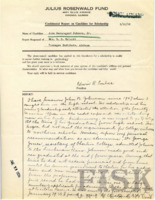
 Fellowship candidate reports on John Beauregard Johnson, Jr. written by Mrs. B.B. Walcott, Mr. Howard Thurman, Dr. N.S. Duff, Dr. Howard T. Karsner, Mr. E.F. Bosworth on March 30, 1936. Dr. Branch sought further training in Pathology. Mr. Johnson had attended Oberlin College and Tuskegee Institute, and he had interned at Cleveland City Hospital, he was also the only Negro in his class in Medical school. Mr. Johnson was regarded as a young man of real ability, sound scholarship, unusual social intelligence, thoroughness and critical judgement, and he was also pretty athletic. Even Mr. Thurman mentioned Mr. Johnson would make a significant contribution in his chosen field.